


What is Pixel Pitch and How Do You Measure It?
One of the most important measurements in digital signage is the pixel pitch, which describes the density of the pixels on an LED display and determines the sign’s resolution.
What is Pixel Pitch?
Pixels are made up of three LEDs (red, green, blue). The pitch is the measurement in millimeters from the center of one pixel to the center of the adjacent pixel—both vertically and horizontally. The smaller the pitch, the higher the resolution of the display.
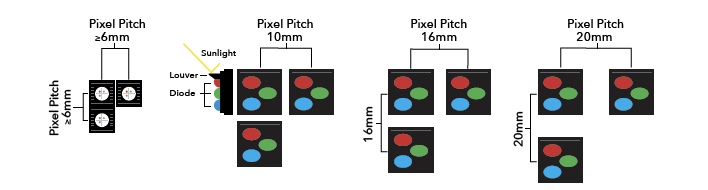
In its products, Optec uses two types of LED diodes. Surface-mounted diode (SMD) LEDs are soldered directly onto the flat surface of a circuit board. Discrete pixels are an individual lighting node or separate physical diode cluster containing red, green, and blue colors that features its own built-in control microchip.

Calculate Your Viewing Distance
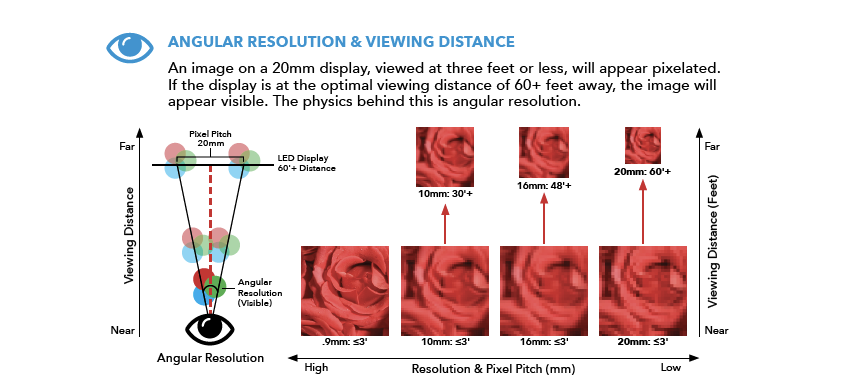
As the resolution on a digital display gets higher, the recommended viewing distance also gets closer. This is because the closer the pixels are, the less our eyes notice the “dots” or pixels that make up the display.
As a general rule, if you multiply your sign’s pixel pitch by three, you will get the minimum recommended viewing distance in feet. For example, a sign with a pixel pitch of 10mm has a minimum viewing distance of 30 feet. Multiply that same pixel pitch by six to get the ideal viewing distance. So that same 10mm sign would have an ideal viewing distance of 60 feet.
Indoor digital displays are viewed from much closer, so the range of pixel pitches is much tighter. For example, depending on the product, Optec offers indoor pixel pitches from .95mm-4.8mm in its Opt product line.
Outdoor digital displays—such as roadside billboards, tall pylon signs, or scoreboards mounted in a stadium—are typically viewed from much further away, so the pixel pitches can be higher. In its outdoor display products, Optec offers pixel pitches ranging from 3.9mm-25mm.
How Content Can Affect Pixel Pitch
The type of content you want to display on your digital sign will also help determine the needed pixel pitch. As a general rule, detailed content with lots of text requires a tighter pixel pitch for ideal readability. Whereas larger pixel pitches usually suffice for video, motion graphics, and simple images and logos.
By considering the installation site, viewing distance, and type of content that will be displayed, you can arrive at the ideal pixel pitch for your application.
Learn more about Optec’s line of digital display products by visiting optec.com.